Houston is not simply a large technology market. It is a business environment shaped by industries where mobile applications often need to solve complex operational problems.
Energy companies may need field-service applications that work with limited connectivity. Healthcare organizations need secure patient and workforce experiences. Logistics businesses need real-time tracking and dispatch. Construction teams need mobile access to project information from the field.
That makes mobile app development in Houston less about simply building an iOS or Android application and more about building software that fits the way a business actually operates.
This guide explains what Houston businesses should consider before investing in a mobile application from industries and costs to timelines, technology choices, and selecting the right development partner.
Why Houston Businesses Are Investing in Custom Mobile Apps
Houston has one of the most diverse major-city economies in the United States. While energy remains a defining sector, the city also has significant activity across healthcare, manufacturing, construction, logistics, aerospace, technology, and professional services. The City of Houston identifies energy, healthcare, aerospace, advanced manufacturing, and international commerce among the region’s major strengths.
For many businesses, mobile apps are becoming an operational layer between employees, customers, systems, and physical operations.
A custom app can help businesses:
- Replace paper-based workflows
- Give employees access to information in the field
- Improve customer self-service
- Automate approvals and reporting
- Connect employees with internal systems
- Track assets, vehicles, equipment, or orders
- Improve scheduling and dispatch
- Capture data at the point of work
- Provide real-time business visibility
- Create new digital products and revenue streams
The important question is not simply, “Do we need an app?”
It is:
“Which business problem should the app solve, and what measurable outcome should it create?”
That distinction can have a major impact on development scope and investment.
Houston Industries Driving Mobile App Demand
Houston’s economy creates some particularly strong use cases for mobile applications.
1. Energy & Oil and Gas
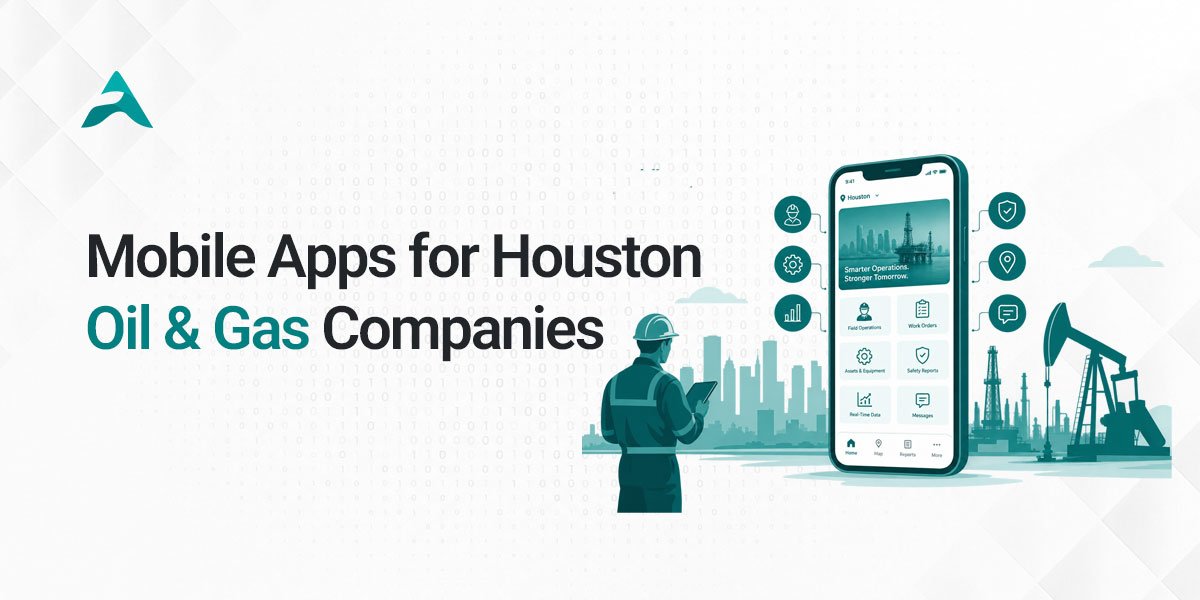
Energy remains one of Houston’s defining industries. The Harris County Economic Development office describes the region as a leading global center for the oil and gas industry, while Greater Houston Partnership data continues to show the scale of energy-related employment and petrochemical production in the region.
Mobile applications can support:
- Field inspections
- Equipment and asset tracking
- Maintenance management
- Safety reporting
- Crew scheduling
- Work orders
- Inventory management
- IoT and sensor dashboards
- Field documentation
- Incident reporting
For field teams, offline-first functionality can be particularly important. Workers cannot always depend on continuous connectivity at industrial sites or remote locations.
A well-designed application can allow employees to capture information offline and synchronize it when connectivity becomes available.
Related resource: [Energy & Oil and Gas App Development in Houston]
2. Healthcare & Life Sciences
Houston’s healthcare ecosystem creates another major opportunity for mobile applications.
The Texas Medical Center is home to a large concentration of healthcare institutions and is described by UTHealth Houston as the world’s largest medical center.
Healthcare applications may include:
- Patient portals
- Appointment scheduling
- Digital intake
- Telehealth experiences
- Medication reminders
- Provider applications
- Remote monitoring
- Staff communication
- Patient engagement
- Clinical workflow tools
Healthcare projects also introduce additional requirements around privacy, security, accessibility, integrations, and regulatory considerations.
The right development approach therefore needs to account for the data and workflow requirements from the beginning rather than treating security as an afterthought.
Related resource: [Healthcare App Development in Houston]
3. Logistics & Transportation
Houston’s location and infrastructure make logistics another strong mobile-app use case.
The City of Houston reports more than 600 trucking firms operating in the city, alongside major rail infrastructure.
Potential applications include:
- Fleet management
- Driver applications
- Delivery tracking
- Route management
- Dispatch systems
- Proof of delivery
- Warehouse workflows
- Barcode scanning
- Customer tracking portals
- Real-time notifications
For logistics businesses, the value often comes from connecting mobile users with the company’s existing operational systems.
4. Construction
Construction teams frequently work across multiple locations, making mobile access to project information valuable.
Custom applications can support:
- Site inspections
- Daily reports
- Time tracking
- Safety checklists
- Equipment management
- Document access
- Progress reporting
- Issue tracking
- Approval workflows
- Communication between field and office teams
Instead of requiring workers to return to a desktop system to complete routine tasks, mobile applications can bring those workflows directly to the job site.
5. Aerospace & Advanced Manufacturing
Houston also has a significant aerospace and advanced manufacturing ecosystem. Harris County identifies aerospace and aviation, advanced manufacturing, technology, and energy among its key industry sectors.
Applications in these environments may focus on:
- Asset management
- Inspection workflows
- Maintenance
- Workforce coordination
- Inventory
- Quality assurance
- Operational dashboards
- Secure internal communication
For enterprise applications, integration with existing ERP, CRM, inventory, identity, and reporting systems can be just as important as the mobile interface itself.
How Much Does Mobile App Development Cost in Houston?
There is no single “Houston app development price.”
Two applications that both have 20 screens can have dramatically different budgets depending on their underlying technology and business requirements.
A basic MVP with authentication and a limited number of workflows may cost significantly less than an enterprise application requiring complex integrations, real-time functionality, advanced security, multiple user roles, and sophisticated backend infrastructure.
As a planning framework, Houston agencies currently publish ranges spanning roughly $15,000 for focused MVPs to $100,000+ for complex enterprise applications, while some providers quote considerably broader ranges depending on scope. These figures should be treated as planning estimates rather than an official Houston market average.
Factors that influence app development cost
1. App complexity
Simple informational applications require less engineering than platforms with complex workflows.
2. Number of platforms
Building separately for iOS and Android can increase development effort compared with a well-planned cross-platform approach.
3. Backend development
Your application may require APIs, databases, authentication, dashboards, cloud infrastructure, and administration tools.
4. Integrations
Connecting to ERP, CRM, payment, healthcare, logistics, IoT, or third-party systems can significantly affect scope.
5. Security and compliance
Applications handling sensitive business or healthcare data require stronger security controls and testing.
6. Advanced functionality
Features such as real-time tracking, geolocation, offline synchronization, payments, AI-assisted workflows, or complex analytics can increase development requirements.
7. Long-term support
Budgeting should also include maintenance, monitoring, updates, security patches, infrastructure, and future feature development.
The best way to estimate cost is therefore to define the business requirements first and then scope the product—not the other way around.
Related resource: How Much Does App Development Cost in Houston?
How Long Does It Take to Build a Mobile App in Houston?
Project timelines depend on complexity, team structure, integrations, and how clearly requirements are defined.
A rough planning model might look like this:
| Project Type | Typical Planning Timeline |
|---|---|
| Simple MVP | 4–10 weeks |
| Moderate Custom Application | 10–16 weeks |
| Complex Application | 4–7+ months |
| Enterprise Platform | 6–12+ months |
These are planning ranges, not guarantees.
A project with fewer screens can still take longer if it requires complicated integrations, regulatory requirements, offline synchronization, multiple user roles, or complex backend architecture.
A typical development lifecycle includes:
- Discovery and requirements
- Product strategy
- UX/UI design
- Technical architecture
- MVP development
- Quality assurance
- User acceptance testing
- App Store and Google Play preparation
- Launch
- Maintenance and continued development
For larger organizations, it can also make sense to release the product in phases rather than waiting until every planned feature is complete.
Native vs. Cross-Platform: Which Is Right for a Houston Business?
One of the first technology decisions is whether to build native applications or use a cross-platform framework.
Native Development
Native iOS development typically uses Swift, while native Android development commonly uses Kotlin.
Native development can make sense when you need:
- Maximum platform-specific performance
- Deep device integration
- Advanced platform functionality
- Highly specialized user experiences
- Platform-specific optimization
Cross-Platform Development
Frameworks such as Flutter and React Native allow teams to develop applications for multiple platforms from a shared codebase.
This can be attractive when your priority is:
- Faster multi-platform delivery
- Consistent experiences
- Lower duplicated development effort
- Efficient MVP development
- A single product team supporting both platforms
There is no universally “best” technology.
For example, an energy field-service application with demanding offline functionality may have different technical requirements from a consumer marketplace application.
The right question is:
Which technology best supports the product’s users, integrations, performance requirements, budget, and long-term roadmap?
How to Choose a Mobile App Development Partner in Houston
Choosing a development company should go beyond comparing hourly rates.
Before signing a contract, evaluate the partner across five areas.
1. Relevant Industry Experience
Ask whether the company has experience with applications similar to yours.
A company that understands field operations, healthcare workflows, logistics, or enterprise integrations may identify technical requirements earlier than a general-purpose development team.
2. Product Strategy
A good development partner should challenge unclear requirements instead of simply converting a feature list into code.
Ask:
- What should the MVP include?
- What should wait until phase two?
- What metrics should determine success?
- What technical risks do you see?
- What integrations will be required?
3. Technical Capability
Look beyond the mobile framework.
Evaluate experience with:
- Backend development
- APIs
- Cloud infrastructure
- Databases
- Cybersecurity
- DevOps
- Third-party integrations
- Analytics
- AI-enabled workflows where relevant
4. Ownership & Documentation
Clarify who owns:
- Source code
- Design files
- App Store accounts
- Cloud infrastructure
- Documentation
- Intellectual property
This becomes particularly important for businesses planning to operate and expand the application for years.
5. Post-Launch Support
An application does not become “finished” when it reaches the App Store.
Ask about:
- Bug fixes
- OS updates
- Security updates
- Performance monitoring
- Infrastructure management
- Feature enhancements
- Technical support
For a more detailed framework, see our guide on How to Compare App Development Companies in Houston, which covers the key criteria to evaluate when comparing development partners.
Questions to Ask Before Hiring an App Development Company
Before selecting a partner, ask:
Can you show relevant projects?
Look for comparable technical and business challenges—not just attractive screenshots.
Who will actually build the application?
Understand whether development is handled by an internal team, contractors, or a combination.
How do you handle changing requirements?
A strong process should accommodate legitimate product discoveries without creating uncontrolled scope expansion.
What happens after launch?
Clarify maintenance, support, monitoring, and future development.
Who owns the source code and intellectual property?
Make ownership explicit in the agreement.
How do you approach security?
Ask about authentication, authorization, encryption, testing, infrastructure, and data protection.
How will you measure success?
A good app should have business KPIs not simply a successful launch.
Common Mobile App Development Mistakes Houston Businesses Make
Building Too Many Features in Version One
Trying to build everything immediately increases cost, complexity, and time to market. Start with the smallest version capable of validating the core business proposition.
Treating Mobile as a Separate System
If your employees already use an ERP, CRM, warehouse system, or internal platform, the mobile app should usually work with those systems rather than becoming another disconnected database.
Ignoring Field Conditions
For Houston’s industrial, construction, energy, and logistics environments, connectivity and device conditions can matter.
If employees work outside conventional office environments, consider offline capabilities, synchronization, device constraints, and security early.
Choosing Technology Based Only on Price
The cheapest initial quote is not necessarily the lowest-cost solution. A poorly architected application can become expensive to maintain, scale, and rebuild.
Focusing on Design Before Workflow
A polished interface cannot compensate for a broken business process. Start with the users, workflows, systems, and outcomes. Then design the experience around them.
Forgetting the Post-Launch Roadmap
Your first release should be treated as the beginning of product development—not the final destination.
Why Houston Businesses Choose Agile Stormers
Agile Stormers approaches mobile applications as business products rather than isolated pieces of software.
Our work combines strategy, custom engineering, and intelligent automation to help businesses turn ideas and operational challenges into scalable digital products.
For Houston businesses, that can mean building:
- Custom iOS and Android applications
- Cross-platform mobile solutions
- Enterprise mobility platforms
- Healthcare applications
- Field-service applications
- Logistics and tracking solutions
- Customer-facing applications
- MVPs and startup products
- AI-powered mobile experiences
- Applications connected to existing business systems
Our goal is not simply to launch an application.
It is to build a product that can support your business today and evolve as your requirements change.
If you’re evaluating a mobile application for a Houston business, start with the business problem, define the users and workflows, establish measurable outcomes, and then choose the technology and development partner around those requirements.
Final Takeaway
The best mobile app development guide for Houston businesses does not start with a list of programming languages or development rates.
It starts with the business.
Houston’s energy, healthcare, logistics, construction, aerospace, and manufacturing ecosystems create highly specific operational challenges. The most successful applications are built around those challenges, connect with the systems businesses already use, and provide measurable value to customers or employees.
Whether you’re validating an MVP or planning an enterprise mobile platform, the right development strategy can help you control costs, reduce technical risk, and build a product that is ready to scale.
Ready to turn your mobile app idea into a business-ready product? Talk to Expert about your project.
Frequently Asked Questions
How much does mobile app development cost in Houston?
The cost depends on application complexity, platforms, integrations, security, backend requirements, and advanced functionality. Published Houston agency estimates range from roughly $15,000 for focused MVPs to $100,000+ for complex enterprise applications. These are planning estimates rather than fixed Houston-wide prices.
How long does it take to develop a mobile app in Houston?
A focused MVP may take around 6–10 weeks, while a moderate custom application can take approximately 10–16 weeks. Complex and enterprise applications can require several months or longer.
Should my Houston business build a native or cross-platform app?
It depends on your product requirements. Native development can be appropriate for highly platform-specific applications, while Flutter or React Native can be effective when launching across iOS and Android efficiently.
What industries in Houston benefit most from mobile apps?
Energy, healthcare, logistics, construction, aerospace, manufacturing, professional services, and retail can all benefit from custom mobile applications. Houston’s economic profile is particularly strong across energy, healthcare, logistics, aerospace, and manufacturing.
Do Houston businesses need an app built by a local company?
Not necessarily. A Houston business can work with a local agency or a development partner serving Houston remotely. What matters most is relevant industry experience, communication, technical capability, security, ownership, and long-term support.
Can a mobile app integrate with our existing business software?
Yes. Mobile applications can connect with ERP, CRM, payment, inventory, healthcare, logistics, analytics, and other business systems through APIs and other integration methods. The feasibility depends on the systems involved and their available interfaces.
Should we build an MVP first?
For many businesses, yes. An MVP can help validate the core product before committing the full budget to advanced features. However, enterprise applications with established requirements may benefit from a more comprehensive architecture and phased implementation from the beginning.
What should we prepare before contacting a mobile app development company?
Define your target users, business problem, core workflows, desired features, platforms, existing systems, security requirements, budget range, and expected business outcomes. You do not need complete technical specifications the development partner should help turn the business requirements into a technical roadmap.