- AI consulting focuses on strategy identifying where and why to invest in AI before any development begins.
- Most technology failures stem from lack of clarity, not lack of tools.
- AI consulting helps prioritize high-impact opportunities, align AI with business goals, and manage risk.
- Every business function from sales to finance to operations can benefit from AI-driven strategy.
- A phased, well-governed AI roadmap reduces risk and increases long-term ROI.
- Choosing the right AI consulting partner is as important as the AI strategy itself.
Every year, companies spend more on technology than ever before: new software platforms, cloud migrations, automation tools, and now, artificial intelligence. Yet a surprising number of these investments fail to deliver meaningful business results. Budgets get approved, tools get purchased, dashboards get built and six months later, leadership is still asking the same question: “What did we actually get from this?”
The problem is rarely the technology itself. It’s the absence of a clear strategy behind it.
This is exactly where AI consulting comes in. Rather than jumping straight into implementation, AI consulting helps businesses step back and ask the right questions first: Where can AI create real value? What data do we actually have? What’s the right sequence of investments? Which technology partner and architecture make sense for our business, not someone else’s case study?
In fact, McKinsey’s State of AI 2025 report found that nearly nine out of ten organizations now regularly use AI in at least one business function yet most have not embedded it deeply enough into their workflows to realize material enterprise-level benefits. The gap isn’t adoption. It’s a strategy.
In this article, you’ll learn what AI consulting really means, why so many businesses struggle to make sound technology decisions, and most importantly how AI consulting helps companies make smarter technology decisions across every function of the business. We’ll also walk through a practical AI consulting process, industry examples, common mistakes to avoid, and a checklist for choosing the right AI partner.
What Is AI Consulting?
AI consulting is the practice of helping organizations understand, plan, and prioritize how artificial intelligence can be used to solve real business problems before any code is written or any tool is purchased.
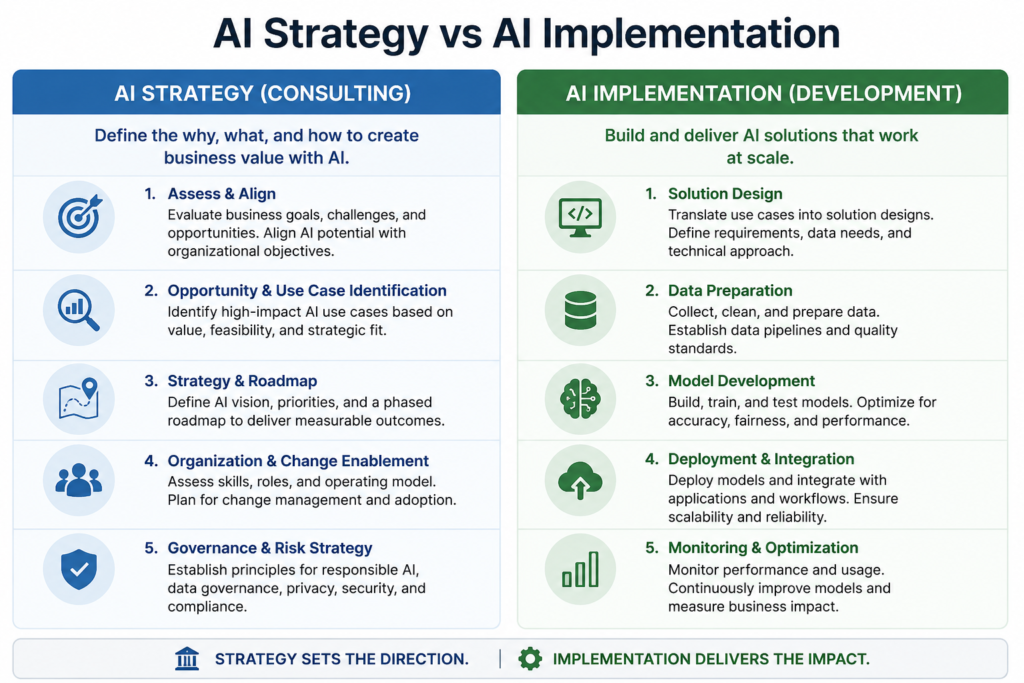
It’s important to understand the difference between AI strategy and AI implementation:
- AI strategy (what AI consulting focuses on) answers why and where — Which business problems are worth solving with AI? What’s the expected ROI? What data and infrastructure do we need?
- AI implementation (software development) answers how — building the actual models, integrations, and applications.
A simple business example: A retail company might know they want to “use AI for customer service.” An AI consultant helps them figure out whether that means an AI chatbot for order tracking, an AI-powered recommendation engine, or automated ticket triaging and which one will deliver the fastest, highest-value results based on their existing systems and customer data.
Without this strategic layer, companies often invest in the wrong tools, hire the wrong talent, or build solutions that never get adopted internally. AI consulting exists to prevent exactly that.
Why Businesses Struggle with Technology Decisions
Most leadership teams aren’t short on ambition they’re short on clarity. Common challenges include:
- Too many technology options: from off-the-shelf SaaS tools to custom-built platforms, the sheer number of choices creates decision paralysis.
- Unclear ROI: many AI vendors promise transformation but rarely quantify what success looks like.
- Legacy systems: outdated infrastructure makes it hard to know what’s even possible without a major overhaul.
- Poor planning: technology purchases driven by urgency or competitor pressure rather than a defined roadmap.
- Choosing the wrong development approach: building custom software when an existing tool would do, or vice versa.
- Lack of in-house AI expertise: most SMEs and even many enterprises don’t have dedicated AI strategists on staff.
- Data quality issues: AI is only as good as the data behind it, and most companies underestimate how much cleanup is required.
- Budget constraints: limited resources mean every technology decision carries real opportunity cost.
“The biggest risk in AI adoption isn’t the technology it’s making decisions without a strategy to guide them.”
Without expert guidance, companies often move fast in the wrong direction which costs more time and money than moving deliberately in the right one.
How AI Consulting Helps Companies Make Smarter Technology Decisions
This is where AI consulting delivers its core value turning ambiguity into a clear, prioritized path forward.
Identifying High-Impact AI Opportunities:
The challenge: Businesses often don’t know where AI can create the most value every department seems to have a use case, but not all are worth pursuing.
How AI consulting solves it: Consultants assess existing workflows, data availability, and business goals to identify opportunities with the highest potential impact and lowest implementation risk.
Practical example: A logistics company assumes AI should optimize delivery routes first. After assessment, consultants find that automating invoice processing delivers faster ROI with far less complexity.
Expected outcome: A prioritized list of AI opportunities ranked by feasibility and business value not guesswork.
Aligning AI with Business Goals:
The challenge: AI projects often get built in isolation from actual business objectives, resulting in “cool” solutions that don’t move the needle.
How AI consulting solves it: Consultants connect every proposed AI initiative directly to measurable business KPIs revenue growth, cost reduction, customer retention, or operational speed.
Practical example: Instead of building a general-purpose chatbot, a SaaS company aligns its AI investment with a specific goal: reducing customer churn by improving response times.
Expected outcome: AI initiatives that directly support strategic business priorities.
Building an AI Roadmap:
The challenge: Without sequencing, companies try to do everything at once, spreading resources too thin.
How AI consulting solves it: A phased roadmap short-term wins, mid-term projects, long-term transformation ensures manageable, sustainable progress.
Practical example: A manufacturing firm starts with predictive maintenance (quick win), then moves to supply chain forecasting (mid-term), then explores full automation (long-term).
Expected outcome: A realistic, staged plan instead of scattered, disconnected projects.
Selecting the Right Technologies:
The challenge: Choosing between building custom AI solutions, using existing platforms, or a hybrid approach is confusing without technical and strategic expertise.
How AI consulting solves it: Consultants evaluate the company’s existing tech stack, budget, and long-term goals to recommend the most suitable technology path.
Practical example: A startup considering an expensive custom AI platform is instead guided toward a proven third-party API, saving significant development time and cost. In other cases, consultants may recommend the opposite investing in custom software development when off-the-shelf tools can’t support the company’s specific workflows or scale requirements.
Expected outcome: Technology investments that match actual business needs, not vendor hype.
Improving Operational Efficiency:
The challenge: Manual, repetitive processes slow teams down and increase error rates.
How AI consulting solves it: Consultants identify workflows suited for AI-driven automation and intelligent process redesign.
Practical example: An HR team automates resume screening and interview scheduling, cutting hiring time significantly.
Expected outcome: Faster processes, fewer errors, and freed-up staff time for higher-value work.
Reducing Costs Through Automation:
The challenge: Operational costs creep up as manual work scales with business growth.
How AI consulting solves it: By automating high-volume, repetitive tasks, businesses reduce labor costs and operational overhead.
Practical example: A finance team automates invoice reconciliation, reducing processing costs and manual errors.
Expected outcome: Measurable, sustained cost savings across departments.
Making Better Data-Driven Decisions:
The challenge: Leaders often make decisions based on intuition or incomplete data.
How AI consulting solves it: AI-powered analytics and predictive models turn raw data into actionable insight, improving decision quality and speed.
Practical example: A retail chain uses predictive analytics to determine optimal inventory levels by location, reducing both stockouts and overstock.
Expected outcome: Faster, more confident, and more accurate business decisions.
Enhancing Customer Experience:
The challenge: Customers expect fast, personalized experiences, but most businesses lack the tools to deliver at scale.
How AI consulting solves it: Consultants design AI-driven personalization, recommendation, and support systems tailored to customer behavior.
Practical example: An e-commerce brand implements AI-based product recommendations, increasing average order value often delivered through a redesigned web application or mobile experience built around customer behavior data.
Expected outcome: Higher customer satisfaction, retention, and lifetime value.
Managing AI Risks and Compliance:
The challenge: AI introduces new risks: data privacy, bias, regulatory compliance that many businesses aren’t equipped to manage.
How AI consulting solves it: Consultants build governance frameworks covering data security, ethical AI use, and regulatory alignment from day one.
Practical example: A healthcare provider ensures its AI diagnostic tool complies with data privacy regulations before deployment.
Expected outcome: Reduced legal, reputational, and operational risk.
Scaling AI Solutions for Future Growth:
The challenge: Many AI pilots never make it past the pilot stage because they weren’t designed to scale.
How AI consulting solves it: Consultants design solutions with scalability in mind flexible architecture, modular systems, and future-proof infrastructure.
Practical example: A fintech startup’s fraud-detection model, originally built for one market, is architected to expand to new regions without a rebuild.
Expected outcome: AI investments that grow with the business instead of becoming obsolete.
AI Consulting Across Different Business Functions
AI consulting isn’t limited to IT departments it touches every part of the organization:
| Function | How AI Consulting Helps |
| Sales | Lead scoring, sales forecasting, AI-assisted CRM insights |
| Marketing | Customer segmentation, content personalization, campaign optimization |
| Customer Service | AI chatbots, intelligent ticket routing, sentiment analysis |
| Operations | Process automation, workflow optimization, predictive maintenance |
| Human Resources | Resume screening, employee attrition prediction, onboarding automation |
| Finance | Fraud detection, automated reconciliation, financial forecasting |
| Supply Chain | Demand forecasting, inventory optimization, logistics planning |
| Product Development | Feature prioritization using usage data, AI-powered prototyping |
| Executive Decision Making | Real-time dashboards, predictive business intelligence |
Industries Benefiting from AI Consulting
- Healthcare: Predictive diagnostics, patient scheduling optimization, administrative automation.
- Retail & E-commerce: Personalized recommendations, demand forecasting, dynamic pricing.
- Finance: Fraud detection, credit risk modeling, automated compliance reporting.
- Manufacturing: Predictive maintenance, quality control automation, supply chain optimization.
- Logistics: Route optimization, warehouse automation, delivery time prediction.
- Education: Personalized learning paths, administrative automation, student retention prediction.
- Real Estate: Property valuation models, lead qualification, market trend forecasting.
- SaaS: Churn prediction, usage-based personalization, intelligent onboarding.
- Professional Services: Document automation, knowledge management, client insight tools.
Each industry faces distinct challenges, and AI consulting tailors strategy to the specific regulatory, operational, and customer dynamics of that sector rather than applying a one-size-fits-all approach.
Real Business Benefits of AI Consulting
Companies that invest in proper AI consulting typically see benefits such as:
- Better ROI: investments are prioritized by measurable business impact.
- Faster innovation: clear roadmaps accelerate execution instead of stalling in analysis.
- Reduced operational costs: automation removes inefficiencies at scale.
- Increased productivity: teams spend less time on repetitive tasks.
- Smarter investment decisions: technology choices are based on evidence, not trends.
- Competitive advantage: early, well-executed AI adoption differentiates market leaders.
- Better customer satisfaction: personalized, faster service builds loyalty.
- Improved decision-making speed: real-time insights replace slow, manual reporting.
- Reduced implementation risk: pilots and phased rollouts limit downside exposure.
Common Mistakes Businesses Make Without AI Consulting
- Adopting AI without clear objectives; leading to solutions in search of a problem.
- Buying unnecessary AI tools: driven by trends rather than actual need.
- Ignoring data quality: resulting in unreliable or biased AI outputs.
- Lack of employee adoption: even great tools fail without proper change management.
- Unrealistic expectations: assuming AI will instantly transform the business.
- Poor change management: rolling out AI without preparing teams or processes.
- No long-term AI strategy: treating AI as a one-off project instead of an evolving capability.
AI consulting directly addresses each of these by setting realistic expectations, ensuring data readiness, and building adoption plans alongside technical implementation.
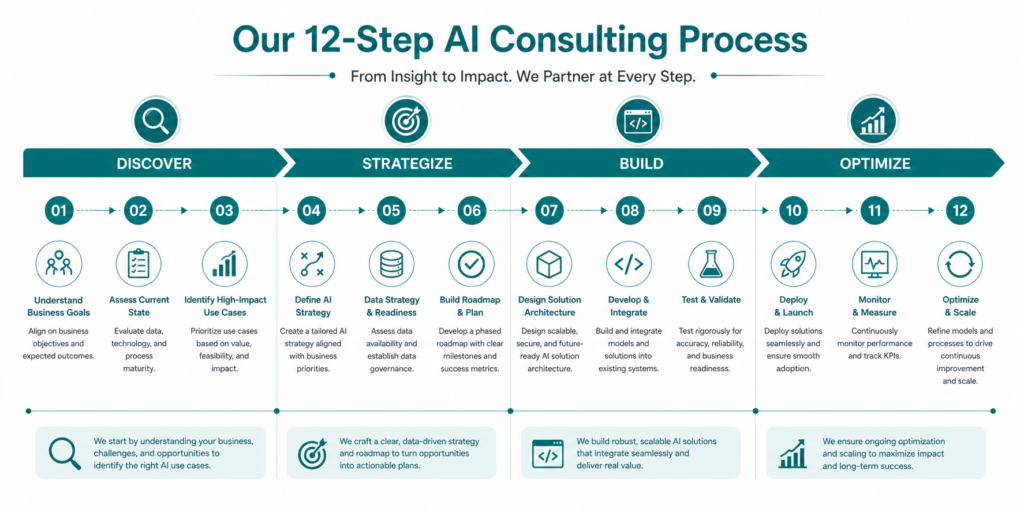
Step-by-Step AI Consulting Process
- Business Discovery: Understanding company goals, pain points, and constraints.
- Process Assessment: Mapping existing workflows and systems.
- Data Evaluation: Assessing data quality, availability, and readiness.
- Opportunity Identification: Pinpointing high-value AI use cases.
- AI Strategy Development: Defining goals, KPIs, and priorities.
- Technology Selection: Choosing the right tools, platforms, or custom-build approach.
- Solution Design: Architecting the solution for scalability and integration.
- Pilot Project: Testing on a small scale to validate value before full rollout.
- AI Integration: Deploying the solution into existing systems and workflows.
- Employee Training: Ensuring teams understand and adopt the new tools.
- Performance Monitoring: Tracking KPIs against expected outcomes.
- Continuous Optimization: Refining the solution based on real-world performance.
Emerging AI Trends Business Leaders Should Watch
According to Gartner’s Top Strategic Technology Trends, AI is no longer experimental; it’s becoming embedded in how industries think, decide, and operate, with governance and orchestration emerging as top priorities for technology leaders. Business leaders should keep an eye on:- Generative AI; content creation, code generation, and knowledge assistance at scale.
- AI Agents & Autonomous Workflows: systems that execute multi-step tasks with minimal human input.
- Hyperautomation : combining AI, RPA, and process mining to automate entire workflows end-to-end.
- Predictive Analytics : anticipating trends and outcomes before they happen.
- AI + IoT : combining connected devices with intelligent decision-making.
- Intelligent Business Applications : software that adapts and recommends actions in real time.
- Responsible AI & Explainable AI : ensuring AI decisions are transparent and fair.
- AI Governance : formal policies for how AI is developed, deployed, and monitored.
Business leaders don’t need to master the technical details of these trends but understanding their potential business impact helps in making informed, forward-looking decisions.
How to Choose the Right AI Consulting Partner
When evaluating an AI consulting company, look for:
- Industry experience — familiarity with your sector’s specific challenges.
- Technical expertise — proven capability across AI, software, and data engineering.
- Strategic thinking — a partner who asks about business goals, not just technical specs.
- Portfolio — demonstrated success with similar projects.
- Communication — clear, jargon-free explanations throughout the engagement.
- Scalability — ability to support you from pilot to enterprise-scale deployment.
- Security practices — strong data privacy and compliance standards.
- Long-term support — ongoing optimization, not just a one-time handoff.
Conclusion
Technology alone has never been a guarantee of business success. Strategy is what turns technology into results. As AI continues to reshape industries, the companies that win won’t necessarily be the ones that adopt AI first, but the ones that adopt it thoughtfully.
AI consulting gives business leaders the clarity, roadmap, and expertise needed to make confident technology decisions reducing risk, improving ROI, and building a sustainable competitive advantage. Whether you’re a startup exploring your first AI use case or an enterprise scaling a multi-year digital transformation, the right strategic guidance makes all the difference between a costly experiment and a lasting business advantage.
Explore to see how these services come together in real projects, or get in touch to start a conversation about your technology roadmap.