

Artificial intelligence (AI) has rapidly evolved from an emerging innovation into a core business technology. What was once considered a long-term investment is now a strategic priority for organizations across industries. According to recent industry research, 78% of businesses now use AI in at least one business function, up from 55% just one year earlier marking one of the fastest technology adoption rates in recent history.
This isn’t hype. It’s a fundamental shift in how businesses operate, compete, and grow. From automating repetitive tasks to predicting customer behavior before it happens, AI has moved from being a futuristic concept to a competitive necessity. Companies that delay adoption aren’t just missing an opportunity; many are actively falling behind competitors who are already using AI to work faster, spend less, and serve customers better.
In this guide, you’ll gain a practical understanding of what AI means for modern businesses, explore how it is transforming industries across the globe, examine the common challenges organizations face during implementation, and discover a clear roadmap for adopting AI successfully. Whether you’re a startup founder exploring your first AI-powered solution or a business leader planning a large-scale digital transformation, this guide will provide the insights needed to make informed decisions with confidence.
What Is Artificial Intelligence?
Before diving into how AI is changing business, it helps to understand what these terms actually mean without the jargon.
- Artificial Intelligence (AI) is technology that enables machines to perform tasks that normally require human intelligence, understanding language, recognizing patterns, making decisions, and solving problems.
- Machine Learning (ML) is a subset of AI where systems learn from data instead of being explicitly programmed for every scenario. Think of a system that gets better at detecting fraud the more transactions it processes.
- Generative AI refers to AI systems that create new content text, images, code, or audio based on patterns learned from massive datasets. Tools like ChatGPT are the most familiar example of generative AI in action.
- Predictive Analytics uses historical data and AI models to forecast future outcomes, such as predicting which customers are likely to churn or which products will sell out next month.
- Automation (when combined with AI) means software that doesn’t just follow fixed rules, but can adapt, learn, and handle exceptions moving beyond traditional “if this, then that” workflows.
- The key difference between AI and traditional software: Traditional software follows rules you explicitly program. AI-powered software learns patterns from data and improves over time, often making decisions or predictions no one explicitly coded it to make.
Why AI Is Transforming Modern Business
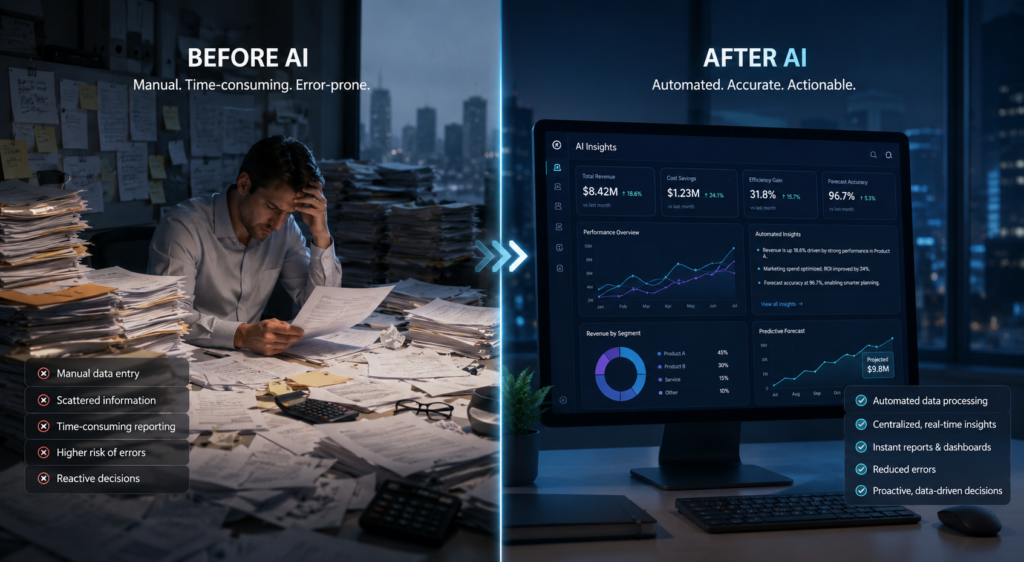
Businesses aren’t investing in AI because it’s trendy, they’re investing because the return is measurable. Deloitte’s 2026 State of AI in the Enterprise report found that improving productivity and efficiency tops the list of benefits from enterprise AI adoption, with two-thirds of organizations reporting real gains. Separately, McKinsey’s most recent Global AI Survey found that organizations are now seeing an average return of roughly 5-6x on AI investments within just over a year of deployment.
Here’s why organizations across every size and sector are prioritizing AI:
- Increased Efficiency: Tasks that once took teams hours can now be completed in minutes, freeing employees to focus on higher-value work.
- Faster Decision-Making: AI processes and interprets large volumes of data instantly, giving leaders real-time insights instead of waiting on weekly or monthly reports.
- Lower Operational Costs: Automating repetitive processes reduces the labor and error costs associated with manual work.
- Better Customer Experiences: AI enables personalization and responsiveness at a scale no human team could match alone.
- Smarter Business Insights: Predictive models surface patterns in customer behavior, market trends, and operations that would otherwise stay hidden in spreadsheets.
- Competitive Advantage: Businesses using AI report they’re better positioned to stay ahead of competitors who haven’t yet adopted these tools, particularly in customer-facing functions.
Top Ways Artificial Intelligence Is Changing Business
Intelligent Business Automation
AI-powered automation goes beyond simple task automation it can handle exceptions, adapt to new scenarios, and continuously optimize workflows. Businesses are using it to eliminate repetitive manual work in data entry, invoice processing, scheduling, and reporting, freeing employees to focus on strategic work rather than administrative tasks
AI-Powered Customer Support
Chatbots and virtual assistants now handle a significant share of customer interactions without human involvement. Industry data shows virtual assistants handle roughly two-thirds of initial customer inquiries across major service providers, offering 24/7 availability and dramatically faster response times all while reducing the cost of running a large support team.
Smarter Decision-Making
Predictive analytics and AI-driven business intelligence tools give leadership teams the ability to make data-driven decisions rather than relying on gut instinct. This shows up in everything from inventory planning to hiring decisions to marketing budget allocation.
Personalized Customer Experiences
Recommendation engines the same technology behind Netflix and Amazon’s “you might also like” suggestions are now standard tools for businesses of every size. By analyzing customer behavior, AI enables personalized marketing messages, product recommendations, and content that feels tailor-made for each individual user.
Sales and Marketing Optimization
AI is reshaping how businesses attract and convert customers through lead scoring (identifying which prospects are most likely to buy), marketing automation, real-time campaign optimization, and AI-generated content that helps marketing teams produce more without expanding headcount.
HR and Recruitment
From resume screening that surfaces the most relevant candidates in seconds, to tools that flag early signs of employee disengagement, AI is helping HR teams make faster, more informed decisions about talent acquisition and employee engagement.
Finance and Risk Management
Financial institutions and finance departments use AI to detect fraudulent transactions in real time, forecast cash flow and revenue with greater accuracy, and identify opportunities for expense optimization across the organization.
Healthcare Applications
In healthcare, AI supports diagnostics by identifying patterns in medical imaging that are easy to miss with the human eye, streamlines patient management systems, and accelerates medical research by analyzing data at a scale no research team could match manually.
Manufacturing and Supply Chain
Manufacturers are using AI for predictive maintenance, identifying equipment issues before they cause costly downtime as well as inventory optimization and automated quality control on production lines.
AI in Mobile and Web Applications
One of the most practical ways businesses are putting AI to work is inside the mobile apps and websites their customers already use every day. Modern applications are becoming noticeably smarter through:
- Personalized in-app experiences based on user behavior
- AI-powered search that understands intent, not just keywords
- Smart product or content recommendations
- Voice interfaces for hands-free interaction
- Image recognition for search, verification, or content moderation
- Intelligent automation that streamlines in-app workflows
Building these capabilities well requires more than plugging in an API; it takes thoughtful AI Consulting and skilled Mobile Application Development to design AI features that genuinely improve the user experience rather than feeling bolted on. The same applies to businesses looking to embed AI into their Web Application Development or Website Development projects, where AI-driven personalization and search can meaningfully improve conversion rates and customer satisfaction.
Real Business Benefits of AI
The impact of AI adoption isn’t theoretical it shows up in measurable business outcomes:
- Higher Productivity: Deloitte’s 2026 research found two-thirds of enterprises adopting AI report meaningful productivity and efficiency gains.
- Reduced Costs: Automating manual processes consistently lowers operational overhead, particularly in customer service and back-office functions.
- Increased Revenue: Businesses using AI-driven personalization and recommendation engines report higher conversion rates and average order values.
- Better Customer Retention: Faster response times and personalized experiences directly improve customer satisfaction and loyalty.
- Improved Employee Efficiency: Employees using AI tools report completing tasks significantly faster, allowing them to focus on higher-value strategic work.
- Faster Innovation: AI shortens the cycle between identifying an opportunity and shipping a solution, whether that’s a new feature, campaign, or internal process.
- Competitive Differentiation: Organizations that adopt AI early and effectively are positioning themselves as the technology leaders in their industries, a distinction that compounds over time.
Common Challenges of AI Adoption

AI adoption isn’t without obstacles, and being upfront about them is part of doing this well. Common challenges organizations face include:
- Data Privacy and Security Concerns: AI systems often require access to large volumes of sensitive data, raising legitimate questions about how that data is stored, used, and protected.
- Integration with Existing Systems: Many businesses run on legacy software that wasn’t built with AI in mind, making integration a real technical hurdle.
- High Initial Investment: Building or implementing AI capabilities requires upfront investment in tools, talent, or outside expertise a cost that gives some businesses pause, even when the long-term ROI is strong.
- Employee Resistance: Change management is often harder than the technology itself. Employees may worry about job security or feel unsure how AI fits into their existing workflows.
- AI Ethics: Questions around bias in AI decision-making, transparency, and accountability are increasingly important considerations for responsible adoption.
- Choosing the Right AI Strategy: With so many tools and vendors available, many businesses struggle simply to identify which AI investments will actually move the needle for their specific goals.
The good news: none of these challenges are unique to your business, and none of them are reasons to avoid AI altogether. They’re reasons to approach adoption with proper planning. This is exactly where experienced AI Consulting makes a measurable difference helping businesses identify the right use cases, address data and security concerns from the start, and build a realistic roadmap instead of adopting AI in a scattered, reactive way.
Industries Being Revolutionized by AI
AI’s impact isn’t confined to the tech sector. Nearly every industry is being reshaped:
- Healthcare: faster diagnostics, streamlined patient management, accelerated research
- Finance: fraud detection, algorithmic risk assessment, automated forecasting
- Retail: personalized recommendations, dynamic pricing, inventory optimization
- E-commerce: AI-powered search, chatbots, and personalized product discovery
- Education: adaptive learning platforms and administrative automation
- Logistics: route optimization, demand forecasting, automated warehousing
- Manufacturing: predictive maintenance and automated quality control
- Real Estate: AI-driven property valuation and virtual property tours
- Marketing: content generation, campaign optimization, and audience targeting
- SaaS: AI-embedded features that increase product stickiness and value
- Professional Services: document automation, research acceleration, and client insights
Future Trends in Artificial Intelligence
Businesses that want to stay ahead need to understand what’s coming next, not just what’s already here:
- AI Agents: Autonomous systems capable of completing multi-step tasks with minimal human input are moving from experimental to production use across enterprises.
- Generative AI: Continued advancement in content, code, and design generation is expanding what’s possible for lean teams.
- Autonomous Workflows: End-to-end processes that require little to no manual intervention are becoming realistic for more business functions.
- Hyperautomation: Combining AI, robotic process automation, and machine learning to automate complex, end-to-end business processes.
- AI + IoT: Smart devices paired with AI are enabling real-time monitoring and decision-making in manufacturing, logistics, and retail.
- Edge AI: Processing AI workloads locally on devices rather than in the cloud, reducing latency for real-time applications.
- AI Cybersecurity: Using AI to detect and respond to threats faster than traditional security systems.
- Computer Vision: Expanding applications in quality control, retail analytics, and security.
- Voice AI: More natural, conversational voice interfaces across customer service and product experiences.
- AI-Powered Business Intelligence: Dashboards and analytics tools that don’t just display data but proactively surface insights and recommendations.
- Responsible AI: Growing emphasis on transparency, fairness, and governance as AI adoption scales.
- Human-AI Collaboration: The most successful organizations aren’t replacing people with AI they’re pairing human judgment with AI’s speed and scale.
Businesses that begin preparing for these trends now even before fully implementing them will be far better positioned to adopt them quickly once they become standard practice in their industry.
How Businesses Can Successfully Adopt AI
Successful AI adoption isn’t about implementing every tool at once. It follows a deliberate process:
- Identify Business Challenges: Start with a real problem, not a technology you want to use.
- Define Measurable Goals: Know exactly what success looks like before you begin cost savings, time saved, revenue growth, or customer satisfaction improvements.
- Assess Existing Processes: Understand your current workflows and data quality before layering AI on top of them.
- Start with a Pilot Project: Test AI on a smaller, lower-risk process before scaling company-wide.
- Choose the Right AI Technologies: Not every AI tool fits every business; the right choice depends on your specific goals and existing systems.
- Integrate AI into Existing Systems: Ensure new AI tools work smoothly alongside your current software rather than creating new silos.
- Train Employees: Adoption succeeds or fails based on whether your team understands and trusts the tools they’re being asked to use.
- Monitor Performance: Track the metrics you defined in step two, and be honest about what’s working and what isn’t.
- Continuously Optimize: AI systems improve with ongoing refinement adoption isn’t a one-time project, it’s an evolving capability.
Conclusion
Artificial intelligence has moved past the experimental phase. It’s now a core part of how competitive businesses operate, improving efficiency, sharpening decision-making, and creating customer experiences that weren’t possible even a few years ago. The organizations seeing the greatest results aren’t necessarily the ones with the biggest budgets, they’re the ones approaching AI adoption strategically, starting with clear goals and building from there.
The businesses that will lead their industries over the next decade are the ones investing in AI capability today not by chasing every new tool, but by thoughtfully integrating AI into the parts of their business where it creates real, measurable value. The future of business isn’t just digital. It’s intelligent, adaptive, and increasingly built around AI working alongside human expertise.
Ready to Bring AI Into Your Business?
Exploring how AI could work for your business doesn’t require a massive overhaul on day one. It starts with identifying the right opportunity and building from there with the right expertise.
Whether you’re exploring AI Consulting to define the right strategy, need Software Development to build custom AI-powered tools, want to bring intelligent features into a Mobile Application Development project, or are planning a Web Application Development or Website Development initiative that puts AI to work for your customers, having an experienced partner makes the difference between experimenting with AI and actually seeing results from it.
If you’re ready to explore what AI could realistically do for your business, Contact Agile Stormers we’d welcome the conversation, no pressure, just a clear-eyed look at where the opportunity actually is.